
How to Give Your AI Agent Real Autonomy (Without It Asking You Everything)
I write playbooks - an operations manual - so my AI agent handles the boring work on its own, knows where its data comes from, and only asks me when it truly needs to.
We all have an agent on Telegram or WhatsApp that we throw task after task at, trying to save time (even if we don't always pull it off).
One thing I liked about what I'd built was being able to hand it scheduled tasks that ran every so often and did something -- for example: pull AI news every morning, or check whether I'd left an email unanswered. The nice part about that engine is that it's 100% agnostic. You can ask it to look over meeting minutes or to remind you to take the car to the shop.
From scattered tasks to a playbook
Over the last few weeks I took an extra step with this, trying to make it truly an admin assistant working beside me. I started writing what I call a playbook. It's something like that operations manual where you explain how to use the tools (skills or MCPs) as if it were a human. Do everything you can on your own, and ask me what you actually need to ask. Understand what the data source is for each thing, what the limits are, and when it's worth pausing to ask -- and that last part is the hardest. Don't ask me about everything. Don't do things you're not sure about.
The approach I went for was to humanize it as much as possible. How would I do this with a junior? How would I teach them? Ask me the first time. Take notes. Next time, don't ask me. Before you ask me, did you check what the documentation says? All those little things. Or, for example: to an internal teammate you can reply to an email asking what was agreed in a meeting; to a client, write the draft and ask me for the OK before sending it.
I try to give playbooks a similar structure:
- decision matrix and scope
- hard rules and exceptions (and loops)
- escalation (when to escalate to me or to others)
- memories (decisions, learnings, open items, examples)
Today I have several use cases (analyzing emails, Slack and calendars, analyzing meeting minutes, forecasting/planning/allocating teams and resources).
An example: analyzing meeting minutes
Let me give an example, one of my favorites: analyzing meeting minutes.
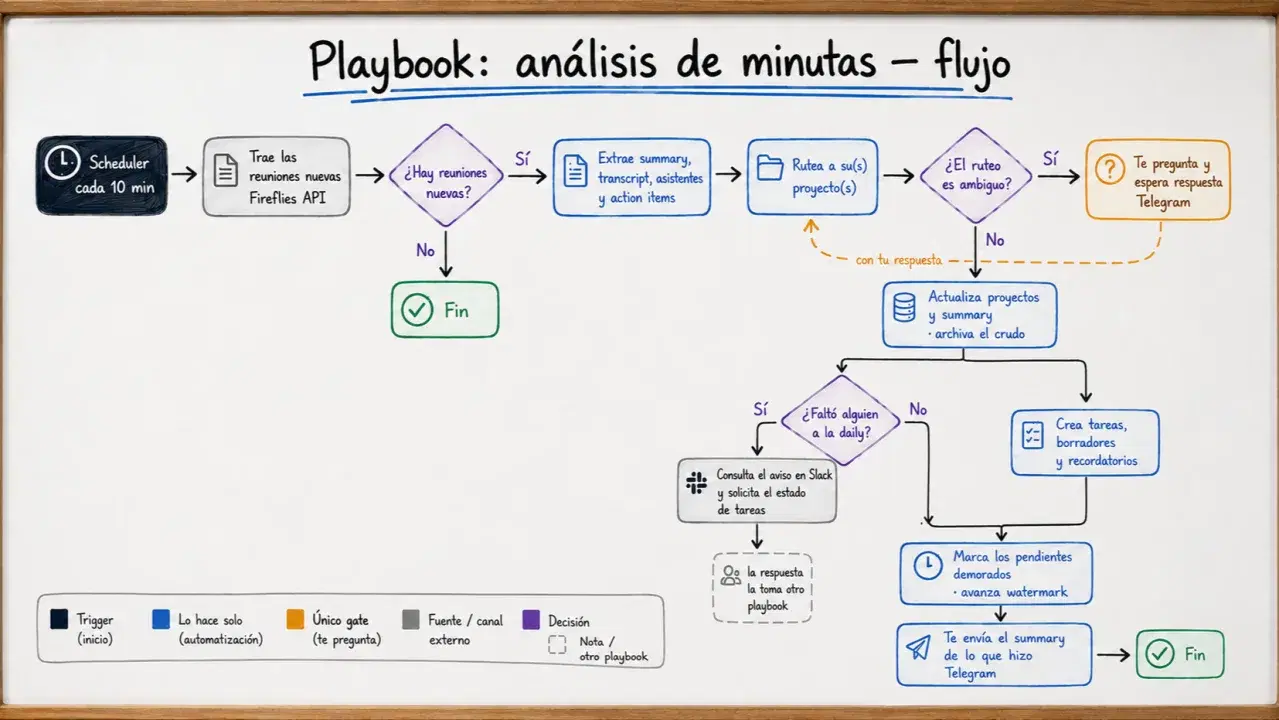
10 a.m., the whole team gets together for the daily. A little later the agent writes to me and confirms:
- That everything said in the meeting has an associated task. If not, it creates the task in the system.
- That every commitment I made has its triggers (if I said I'd chase something down, it drafts it for me; if I said I'd create a task, it creates it; if I said I'd look into a matter, it sets a reminder for me to do it later).
- If someone on the team didn't show up to the meeting, it checks Slack to see whether they said they couldn't make it and asks them for the status of their tasks (another playbook then analyzes that reply).
- It saves the updates to my weekly summary and flags the things that have been dragging for several days [three days ago Juancito said he was going to do something... is it normal for it to take this long?]... yeah, a bit of a snitch.
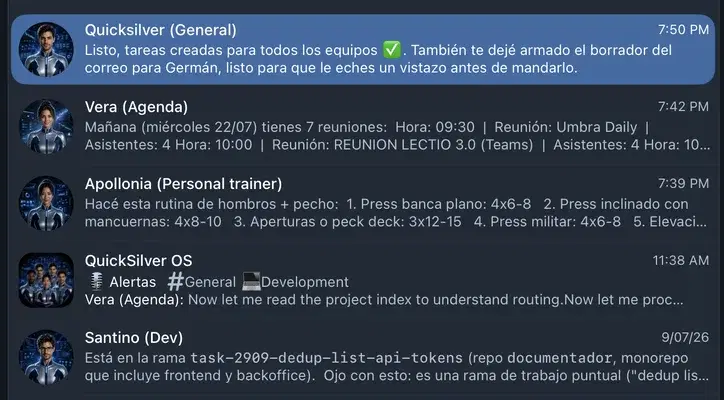
Agents and a group of agents in Telegram.
To wrap up. This new thing I call playbooks -- Anthropic will probably come up with a cooler name for it soon -- but that doesn't change the fact that I'm getting an agent to work with the supervision it needs. To have the autonomy it needs to handle the boring stuff, so I can spend more time on what I actually enjoy.
And you -- how are you handling your assistant's autonomy?
Originally published by Nicolás Middi on LinkedIn.
Want to ship like this?
We embed senior AI-native engineers into your team in one week. Same timezone, no recruiting overhead.
Talk to us